 |
A Simple Electric Circuit
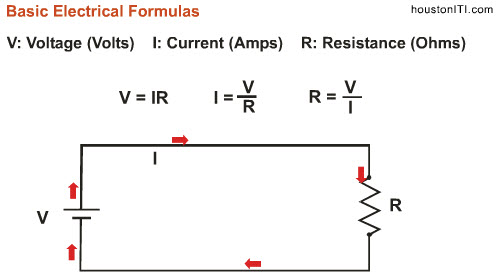
The figure provided here illustrates a simple electric circuit as well as the basic formulas. Let’s look at the circuit first.
On the left hand side a symbol for a battery is shown. This symbol consists of two parallel lines. The bigger line indicates positive side, and the smaller line indicates the negative side of the battery. In later sections we will discuss batteries in more detail. In this circuit, battery is the source for EMF in this case.
The current “I” flows through the entire circuit. It originates from the positive side of the battery, goes through the connecting wires to the resistance, flows through the resistance, and returns to the negative side of the battery.
On the right hand side, the symbol for resistance is shown (labeled R.) As the current flows through the resistance, the resistance heats up - hence, we can say work is done, or a transformation of energy from electrical energy to thermal energy takes place.
Current Flow vs. Electron Flow
Some discussion on a arbitrarily chosen convention: The "current" flow is opposite in direction to the electron flow - this is just a convention and has no practical implications. The exact opposite convention would have served the science equally well. So, to summarize, in any electric circuit, whichever way the electrons are flowing, the current is labeled to flow in the opposite direction. In our circuit shown in the illustration, the current flow is indicated - the direction of electron flow would be exact opposite. This convention has no bearing on our practical calculations but it is good to know.
Numerical Example 1
In an electric circuit you are given the following:
Current = 2 amps
Resistance = 6 ohms
Find the voltage which is causing this current to flow.
Solution
Using the given formula we get:
Voltage = V = I x R = 2 x 6 = 12 volts Answer